

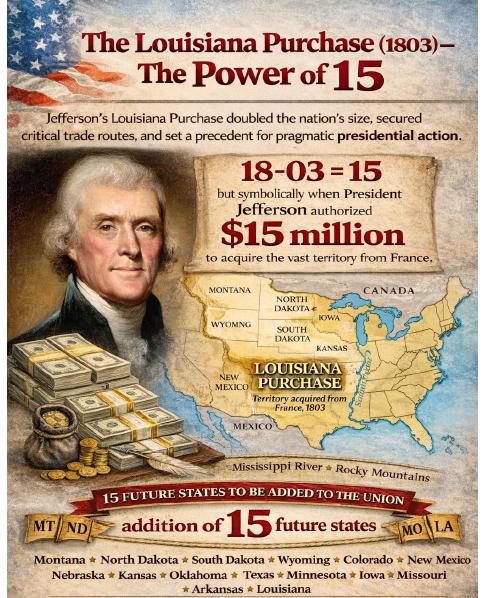
Fifteen million dollars. That's the number at the heart of this mnemonic, and it's worth sitting with just how absurd a bargain it represents: in 1803, Thomas Jefferson paid roughly $15 million for approximately 828,000 square miles of territory stretching from the Mississippi River to the Rocky Mountains, doubling the size of the United States in a single transaction. Measured against what that land would go on to produce over the next two centuries, it's arguably the single best real estate deal in American history. But the price tag isn't really what makes this story interesting for APUSH purposes. What makes it interesting is the contradiction it forced Jefferson to confront in his own political philosophy.
The opportunity arose because Napoleon Bonaparte's ambitions in the Americas had collapsed. France desperately needed money to fund its European wars, and the massive Louisiana Territory, difficult to defend and increasingly costly to hold, suddenly looked more valuable as cash than as colony. Jefferson's negotiators, sent originally just to secure American access to the port of New Orleans — which was critical for western farmers shipping goods down the Mississippi — came home instead with an offer to buy the entire territory. It was, by any measure, an opportunity too good to pass up.
And that's exactly the problem. Jefferson had spent years as the nation's leading voice for strict constructionism, the idea that the federal government possessed only those powers explicitly listed in the Constitution. Nowhere does the Constitution mention the power to acquire foreign territory. A rigidly consistent Jefferson would have had to say no, or at least wait for a constitutional amendment before agreeing to the deal. The Jefferson who actually occupied the presidency did something different: he justified the purchase through the implied powers attached to the president's treaty-making authority, reasoning that if the Constitution empowered the president to make treaties, and treaties could involve acquiring territory, then the purchase was constitutionally sound. It's a flexible, almost Hamiltonian argument coming from the man who had built his entire political identity in opposition to Hamiltonian flexibility.
This is worth dwelling on with students, because it's a genuinely rich example of a recurring pattern in American political history: leaders adjusting their stated principles when the stakes of not doing so become too high. Jefferson didn't abandon strict constructionism because he stopped believing in it. He set it aside because the strategic and economic value of the Louisiana Territory — control of the Mississippi, room for his vision of an agrarian republic to expand indefinitely, and the removal of a major European power from the North American continent — was simply too important to sacrifice for the sake of consistency.
The purchase's downstream effects reached far beyond 1803. It fueled the Lewis and Clark expedition and decades of westward exploration, reinforced the vision of America as a continental agrarian republic that Jefferson had always favored, and set a precedent for presidential initiative in foreign acquisitions that later presidents, including Polk during the Mexican-American War, would draw on. When you connect this article back to the R.E.S.E.T. mnemonic from the previous entry, you've got a genuinely useful comparison question ready-made for class discussion: was the Louisiana Purchase a continuation of Jefferson's reset agenda, or a quiet abandonment of it? Students who can argue both sides of that question with specific evidence are practicing exactly the kind of nuanced reasoning about continuity and change that the AP exam consistently rewards.
Put APUSH Mnemonics Into Practice: Want to use these strategies throughout your AP U.S. History course? Mastery with Mnemonics includes 50 classroom-ready APUSH mnemonic frameworks designed to help students retrieve, organize, and apply essential historical content across all nine APUSH periods. Use them as bell ringers, retrieval practice, review activities, SAQ scaffolds, LEQ planning tools, or cumulative AP exam review.