

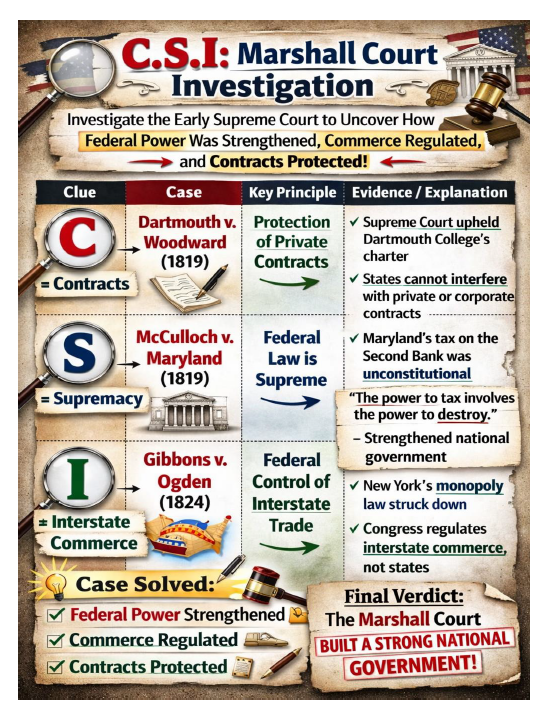
If you had to pick one person most responsible for turning “the judiciary” from an afterthought in the Constitution into a genuinely co-equal branch of government, John Marshall would be very hard to beat. He served as Chief Justice for thirty-four years, from 1801 to 1835, spanning six presidencies, and in that time he wrote a series of decisions that quietly but decisively shifted power toward federal supremacy, and toward the courts themselves as the institution that got to say what the Constitution actually meant. The C.S.I. mnemonic — Contracts, Supremacy, Interstate Commerce — organizes his most important rulings around the constitutional principles they each protected.
The foundational case, and arguably the most important Supreme Court decision in American history, came early: Marbury v. Madison in 1803. On its surface, the case was a minor dispute over a stalled judicial appointment. What Marshall did with it was anything but minor. He used the case to establish judicial review — the principle that the Supreme Court has the authority to strike down laws it finds unconstitutional. Before Marbury, it wasn't obvious that the courts held this power at all. After Marbury, the judiciary had a tool that would let it shape American law for the next two centuries, and Marshall had claimed that tool for the Court without ever provoking the political confrontation that a more direct power grab might have triggered.
The “Contracts” piece of the mnemonic points to Dartmouth College v. Woodward in 1819, where Marshall ruled that New Hampshire couldn't unilaterally rewrite Dartmouth's original royal charter, because doing so would violate the Constitution's contract clause. The practical effect reached well beyond one small college in New Hampshire: the decision protected corporate charters generally from state interference, giving businesses a crucial layer of legal security that helped fuel the corporate expansion of the nineteenth century. The “Supremacy” piece points to McCulloch v. Maryland, decided the same year, where Marshall upheld the constitutionality of the Second Bank of the United States and ruled that individual states couldn't tax federal institutions — famously reasoning that “the power to tax involves the power to destroy,” and that states couldn't be allowed to destroy instruments of the federal government they disagreed with.
The final piece, “Interstate Commerce,” comes from Gibbons v. Ogden in 1824, where Marshall interpreted the Commerce Clause broadly, ruling that the federal government, not individual states, held authority over commerce that crossed state lines. This decision struck down a New York steamboat monopoly and, more importantly, established a precedent for federal economic regulation that would echo forward all the way into the twentieth century, when the Commerce Clause became the constitutional basis for everything from New Deal labor law to civil rights legislation.
Taken together, these rulings reveal a consistent Marshall project: strengthening the federal government relative to the states, protecting private property and contracts from state interference, and establishing the judiciary as the institution with final say over what the Constitution actually permits. For your classroom, C.S.I. works well as more than a memory device for four cases — it's a lens for asking a bigger question. How much of the powerful federal government Americans take for granted today was built not by Congress passing laws, but by one Chief Justice, over three decades, quietly deciding what the Constitution's vague language actually meant? That question sets up beautifully for the HTS comparison later in this unit between Hamilton's financial vision and Henry Clay's American System, since Marshall's rulings gave the federal government exactly the kind of expansive authority that vision required.
Put APUSH Mnemonics Into Practice: Want to use these strategies throughout your AP U.S. History course? Mastery with Mnemonics includes 50 classroom-ready APUSH mnemonic frameworks designed to help students retrieve, organize, and apply essential historical content across all nine APUSH periods. Use them as bell ringers, retrieval practice, review activities, SAQ scaffolds, LEQ planning tools, or cumulative AP exam review.