There's a reason historians sometimes call the election of 1800 the “Revolution of 1800,” and it has nothing to do with violence in the streets. What makes 1800 revolutionary is something quieter and, in its way, more remarkable: political power in the United States changed hands from one party to a bitterly opposed rival party, peacefully, through the mechanisms the Constitution had laid out just thirteen years earlier. It was the first real test of whether a losing faction would accept defeat rather than reach for something more drastic, and the Constitution passed that test.
The campaign itself was ferocious. Thomas Jefferson and the Democratic-Republicans ran hard against what they saw as the Federalists' dangerous drift toward centralized power and monarchy-adjacent elitism under John Adams, seizing especially on the Alien and Sedition Acts, which had criminalized criticism of the government and targeted foreign-born residents suspected of Republican sympathies. This wasn't a polite disagreement about tax policy. Each side genuinely believed the other represented an existential threat to the American experiment, which is worth sitting with for a moment given how familiar that kind of rhetoric might sound to students today.
The election itself nearly broke the system it was supposed to test. Under the electoral rules of the time, Jefferson and his own running mate, Aaron Burr, ended up tied in the electoral vote, throwing the decision into the House of Representatives, which was still controlled by outgoing Federalists. Alexander Hamilton, who despised Jefferson's politics but despised Burr's opportunism even more, ultimately threw his support behind Jefferson and broke the deadlock. It's a genuinely strange historical footnote that Hamilton, of all people, is partly responsible for putting his lifelong political rival in the White House — but it's also a case study in how personal judgment and institutional design interact in moments of real crisis.
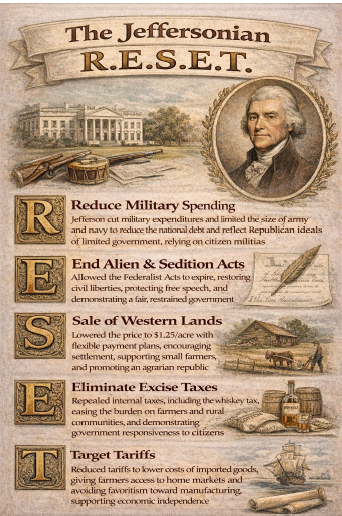
Once in office, Jefferson didn't govern like a revolutionary out to burn down everything the Federalists had built. He governed like someone doing a careful, deliberate reset. He scaled back military spending to chip away at the national debt, let the Alien and Sedition Acts expire rather than fighting to keep them, and made western land dramatically more accessible to ordinary farmers by pricing it at $1.25 an acre with flexible payment terms. He repealed unpopular excise taxes, including the whiskey tax that had provoked violent resistance under Washington, and adjusted tariff policy to favor southern and western agricultural interests over northeastern manufacturing. Every one of these moves reflected the same underlying philosophy: simplicity over centralization, agrarian interests over commercial elites, limited government over an energetic federal state.
The R.E.S.E.T. framing does real conceptual work here, and it's worth being precise with students about what kind of reset this actually was. It wasn't a reset back to the Articles of Confederation — Jefferson still governed within the constitutional structure the Federalists had helped build, and he even expanded federal power dramatically just three years later with the Louisiana Purchase, despite his own stated principles. What reset was ideological direction: a shift in whose interests federal policy would prioritize, and what kind of nation the government was trying to build. That tension between Jefferson's stated small-government principles and his pragmatic willingness to stretch them when it served the nation's interests is a thread worth pulling on now, because it resurfaces almost immediately in his very next major decision.
Put APUSH Mnemonics Into Practice: Want to use these strategies throughout your AP U.S. History course? Mastery with Mnemonics includes 50 classroom-ready APUSH mnemonic frameworks designed to help students retrieve, organize, and apply essential historical content across all nine APUSH periods. Use them as bell ringers, retrieval practice, review activities, SAQ scaffolds, LEQ planning tools, or cumulative AP exam review.