

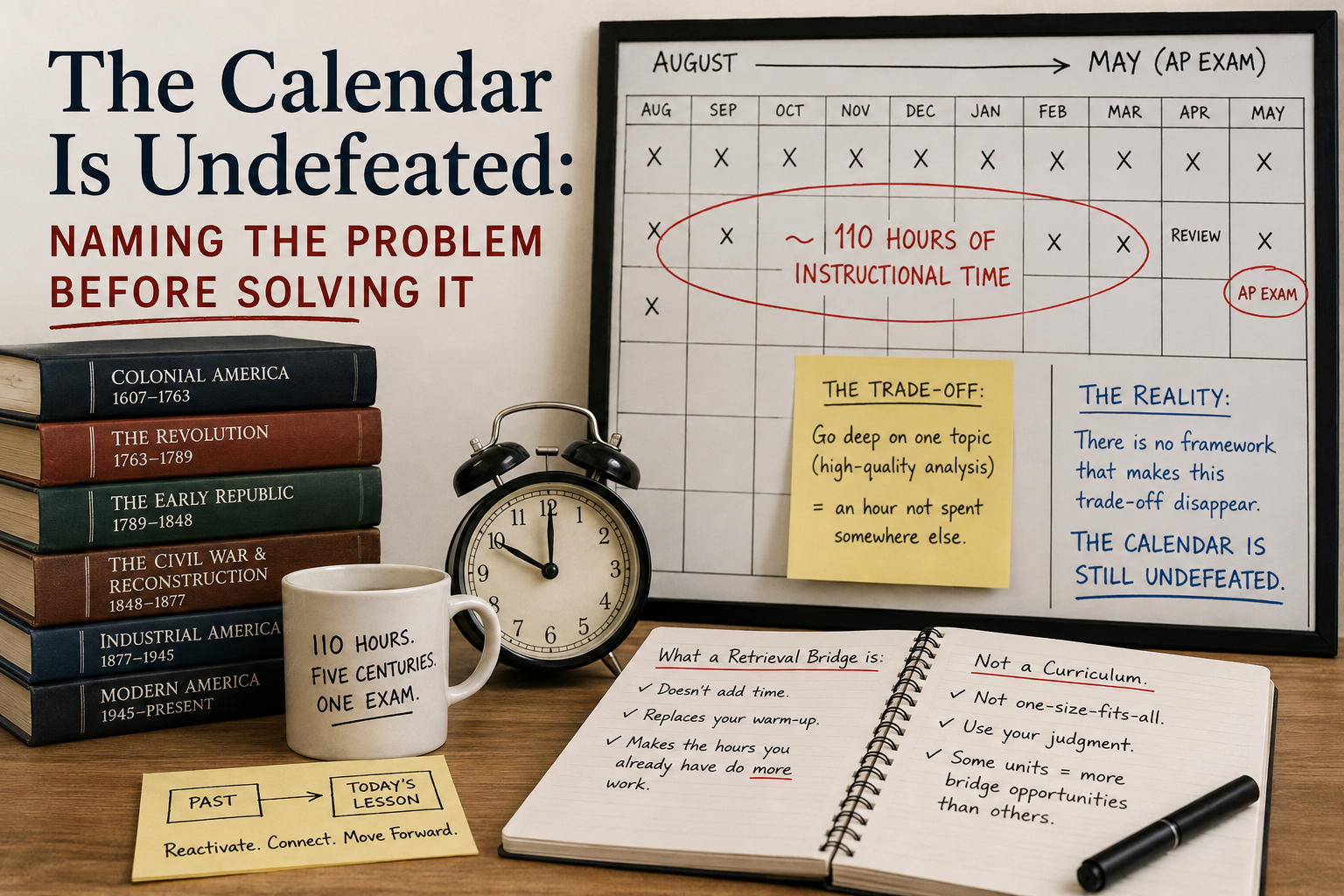
Every AP US History teacher does the same summer math: roughly 110 hours to cover five centuries of content, plus the skills the exam demands. That math never works out, and no framework — including the one in this series — makes the trade-off disappear.
This post is about naming that trade-off honestly before offering any solutions. A slow, rich lesson on primary-source analysis is exactly the teaching students need, and it's also exactly the kind of lesson that eats time you don't have. Something always gives.
What a Retrieval Bridge actually offers isn't more hours — it's a way to make the hours you already have do double duty, using time you'd spend on a warm-up anyway. It's not a curriculum, and it's not meant to be used in every unit. It's one tool for deciding, deliberately, where depth wins and where breadth has to.