


Herbert Aptheker published his pioneering study, American Negro Slave Revolt (1936), defining a slave revolt as an action involving 10 or more slaves, with “freedom as the apparent aim [and] contemporary references labeling the event as an uprising, plot, insurrection, or the equivalent of these.”
In all, Aptheker says, he “has found records of approximately 250 revolts and conspiracies in the history of American Negro slavery.” This is the first fully documented study of Negro slave revolts in The United States. Dr. Aptheker provides proof, obtained by painstaking research, that this content and rebelliousness were not only exceedingly common, but we're characteristic of American Negro slaves. Special attention is paid to the famous slave rebellion of Nat Turner, into the revolts led by Denmark Vesey and Gabriel. This pioneering study remains a major contribution to the destruction of the myth of Afro - American docility.
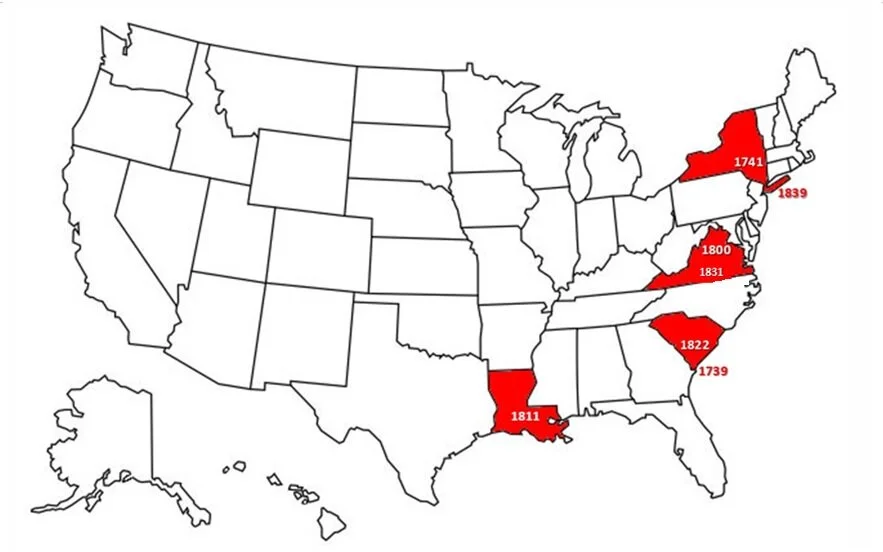
American Slave Rebellions and Uprisings 1739 to 1831
Evidence to dispel the generally accepted notion that the American Negro responded to his bondage with passivity and docility
1739 Stono Rebellion (South Carolina); 1800 Gabriel's Rebellion (Virginia); 1811 Charles Deslondes (Louisiana); 1822 Denmark Vesey Revolt (South Carolina); 1831 Nat Turner's Rebellion, (Virginia)
For the slaves, there were harsh realities. Common to all was the absence of freedom. In addition, there were the slave codes: According to law, .
slaves could not...testify in court against whites; slaves could not...make contracts, or strike whites; slaves could not...own property; slaves could not...travel without permission or own firearms; slaves could not... visit the homes of whites or free blacks; slaves could not...entertain such persons in their quarters.
More severe restrictions came with every slave revolt – and whites lived in constant fear of such revolts.