

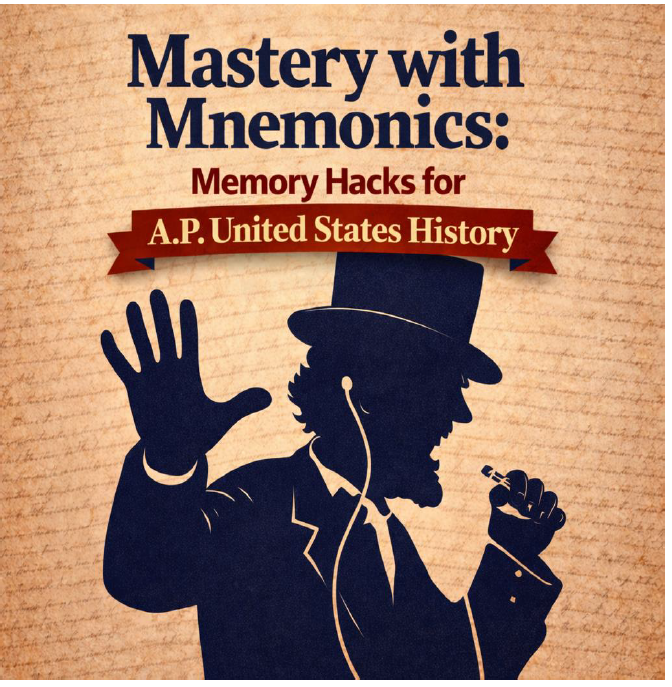
Every AP U.S. History teacher knows the problem before a single class has met: the content is enormous, the calendar is not, and by April, students are trying to hold four centuries of names, dates, events, and turning points in their heads all at once. APUSH mnemonics can help bridge that gap by giving students memorable retrieval cues they can use throughout the year, not just during APUSH exam review in the spring. This series is one answer to that problem. It's not a shortcut around the hard work of historical thinking. It's scaffolding for it.
Why Mnemonics Work for APUSH Review
Starting this week and running roughly every week through the end of April, I’ll be publishing forty posts, each built around a single mnemonic device from Mastery with Mnemonics: Memory Hacks for A.P. United States History. If you’ve taught this course for any length of time, you already know the shape these devices take: a memorable phrase or acronym such as D.I.E.S., C.A.U.S.E., M.A.I.N., or R.O.S.E. that gives students something to grab onto before the details slip away. But a mnemonic on its own is just a party trick if it isn’t attached to real historical content. So every post in this series does three things at once: it unpacks the history behind the device, explains why the device is organized the way it is, and offers a specific way to use it in your own classroom, whether as a bell-ringer, an SAQ scaffold, or a thesis-building tool for an LEQ.
Using APUSH Mnemonics Throughout the School Year
The sequence follows the same chronological path as the AP course itself, which means it also maps cleanly onto the nine official College Board time periods. We open in 1607 with the “Gentleman” Death Trap of Jamestown and close in the early 1980s with the rise of the Moral Majority. Along the way, we’ll stop at the Marshall Court, the cotton gin, the Trail of Tears, Reconstruction, the Gilded Age’s forgettable presidents, the roots of American imperialism, the Great Migration, the New Deal, Executive Order 9066, Vietnam, and the Reagan Revolution, among many other stops. If you’re teaching the course in real time this year, the publishing calendar is designed to arrive roughly alongside where your own pacing guide probably has you: the early republic in the fall, the Civil War and Reconstruction before winter break, and the twentieth century stretching across the spring.
Mnemonics and APUSH Historical Thinking Skills
A few things this series is not. It is not a replacement for primary source work, discussion, or writing practice. The introduction to the book is explicit about this, and I want to be just as clear here. Mnemonics are retrieval and organization tools, not analytical ones. What they’re good at is reducing the cognitive load of a content-dense course so that the analytical work of causation, comparison, continuity and change over time, and contextualization has more room to happen. A student who can retrieve “Militarism, Alliances, Imperialism, Nationalism” in three seconds has more mental bandwidth to spend arguing about which of those four factors mattered most. That argument is where the real historical thinking begins.
More Than Memorization
This series also won’t pretend that every mnemonic tells the whole story. Several posts will end by asking you, and your students, to push back on the device itself. Does G.P.S. actually explain the full moral and historical complexity of Indian Removal, or does it simply organize the surface-level motives? Does M.A.P. capture Manifest Destiny’s appeal without also capturing its consequences? I’d rather build that critical distance in from the start than let a catchy acronym quietly stand in for a more complicated historical reality.
If you’re a teacher, the plan is simple: read each post around the time your own class reaches that unit, borrow whatever is useful, whether it’s the framing, discussion question, or classroom application, and leave the rest. If you’re a student, or the parent of one, these posts should work just as well as a study companion, especially in the weeks leading up to the exam when review season can turn into a blur of flashcards and practice tests.
Put APUSH Mnemonics Into Practice: Want to use these strategies throughout your AP U.S. History course? Mastery with Mnemonics includes 50 classroom-ready APUSH mnemonic frameworks designed to help students retrieve, organize, and apply essential historical content across all nine APUSH periods. Use them as bell ringers, retrieval practice, review activities, SAQ scaffolds, LEQ planning tools, or cumulative AP exam review.